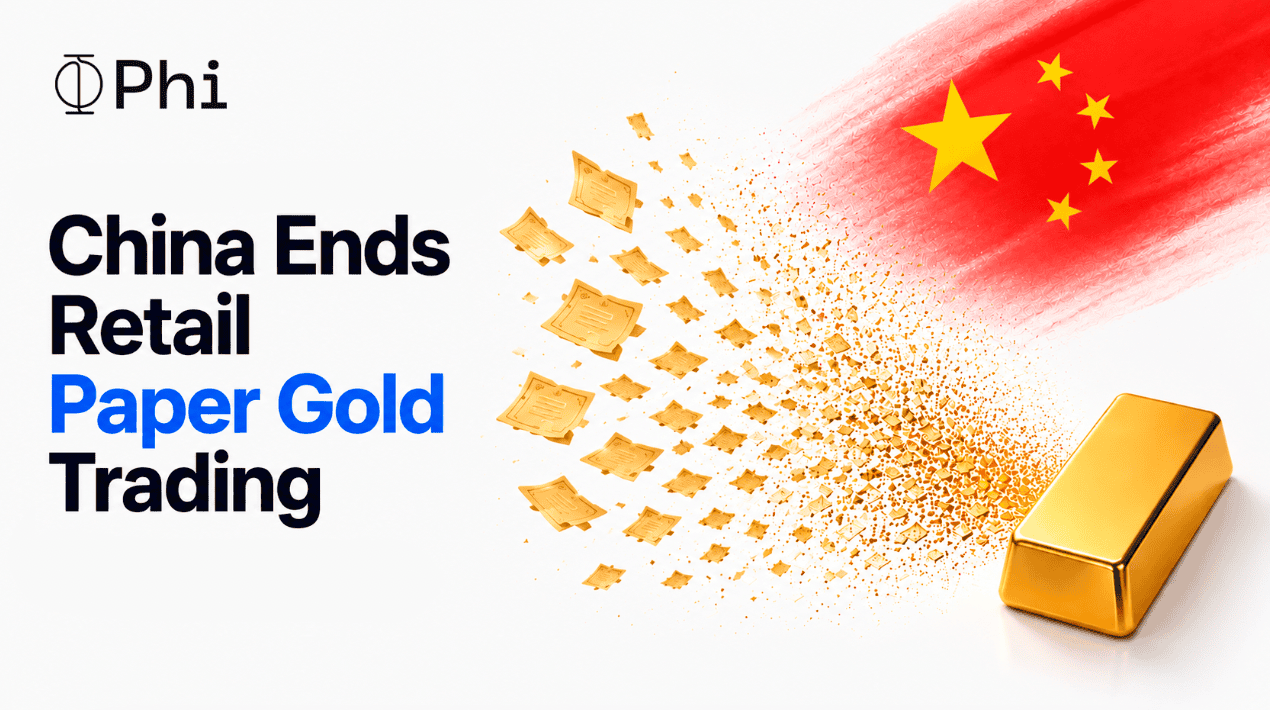
As of the end-of-day settlement on 24 July 2026, the Industrial and Commercial Bank of China, the largest bank in the world by assets, no longer offers retail precious metals trading linked to the Shanghai Gold Exchange. Postal Savings Bank of China, Ping An Bank, China Guangfa Bank and China Construction Bank announced or aligned with the same withdrawal, as reported by the South China Morning Post on 25 June 2026.
What the banks withdrew is their agency service, the personal bidding channel that allowed individual customers to place orders on SGE contracts through mobile banking, online banking and branch counters. ICBC's notice of 24 June listed the affected instruments: spot contracts including Au99.99, Au100g and Au99.95, deferred delivery contracts including Au (T+D) and mAu (T+D), the silver contract Ag (T+D), and the platinum contract PGC30g.
Two details are commonly reported incorrectly. First, the withdrawal is not limited to leveraged products. It covers the entire retail agency business, unleveraged spot contracts included. Second, it is not limited to gold. Silver and platinum contracts are within scope.
What did not change
This is the part most coverage gets wrong, including headlines describing the event as a gold ban or an ETF ban.
Physical gold purchases in China remain entirely unrestricted. Gold ETFs listed on Chinese exchanges are unaffected, as are gold accumulation plans. The Shanghai Gold Exchange changed no rules and continues to operate normally for institutional participants and for physical delivery. Central bank buying continues, with the People's Bank of China adding to reserves for twenty consecutive months through June 2026.
There is one nuance worth stating plainly, because it explains why the story reads as bigger than a bank policy change. Chinese retail investors could not access SGE contracts directly. The bank agency channel was effectively the only route in. So although no exchange rule changed, the practical effect for retail is that the access route has now closed. Bank-level mechanism, exchange-level consequence.
Nothing about owning gold in China has been restricted. What has ended is the ability to trade claims on it through a retail banking app.
Why the banks acted
The stated reason is customer protection, and the numbers support it. Gold reached a record near 5,600 dollars an ounce in January 2026, then fell below 4,000 dollars by late June, a decline of close to 30 percent. Spot gold broke below 4,000 dollars on 25 June, its lowest level since November, on a stronger US dollar and reduced expectations for Federal Reserve rate cuts.
For an unleveraged owner, that is a drawdown. For a customer holding a margined position, it is a margin call, then a forced liquidation, then in many cases a complaint to a regulator. Several banks raised margin requirements to as much as 140 percent before closing the channel, which made the product economically pointless before it was formally withdrawn.
There is also institutional memory at work. In April 2020, Bank of China's Crude Oil Treasure product gave retail clients exposure to WTI futures. When oil settled below zero, retail customers were left with losses they had not understood to be possible, and the bank absorbed the reputational and regulatory consequences. Chinese regulators drew a durable conclusion from that episode about what happens when volatile commodity markets meet retail leverage.
This time they acted before the losses arrived rather than after. The retreat has also been gradual. New retail SGE-linked accounts have been restricted since late 2020, and banks began closing dormant accounts and returning unused margin through late 2025. The 24 July deadline completed a withdrawal that had been underway for years, which is why analysts expected limited immediate price impact.
The distinction that matters: a claim on gold is not gold
Strip away the geography and the headline, and this event makes a very clear statement about a distinction most retail investors never have to think about until it costs them something.
A contract referencing the gold price is a financial exposure. It has a counterparty, a settlement process, and in leveraged form a margin requirement and a liquidation threshold. It behaves like gold right up to the moment the market moves against you, at which point it behaves like debt.
Allocated physical gold is different. It is an asset you own outright. It carries no margin call. A price decline reduces its value on paper, but it cannot force you to sell, and it cannot be closed out by an institution on your behalf.
The 2026 correction demonstrated the difference at scale. Leveraged retail positions did not simply track the gold price, they amplified it in both directions, adding pressure on the way up and becoming forced sellers on the way down. Physical holders were not obliged to do anything.
Where the displaced capital goes
Chinese retail savers now hold cash previously deployed in bank-intermediated gold products, in a country with well developed physical gold infrastructure, from bank-sold bars to jewellery retailers that function as de facto bullion dealers.
The early signal is that this capital does not leave gold, it changes form. According to the World Gold Council's Gold Demand Trends Q1 2026, Chinese bar and coin demand rose 67 percent year on year to a record 207 tonnes, well above the previous quarterly record of 155 tonnes set in 2013. Global bar and coin demand reached 474 tonnes, the second highest quarter on record, and central banks bought a net 244 tonnes.
The reasonable conclusion is not that a single settlement date will move the global gold price. Volumes in the withdrawn products had been declining for years. The more durable observation is that the composition of gold demand continues shifting from synthetic exposure toward metal that has to exist and has to be delivered.
Phi Wallet was built on the same distinction, well before this deadline made it a news story.
When you buy gold through Phi, you own physical gold. It is allocated, insured, independently audited, and held in your name. There is no margin, no leverage, no counterparty position to be closed out, and no scenario in which a price movement obliges you to sell. You can spend it, send it, or hold it, and it remains your metal until you decide otherwise.
That structure is not a response to a market cycle. It is the reason the product exists.
The largest banking system in the world spent five years reaching the conclusion that ordinary savers are better served owning gold than trading claims on it. That is a reasonable conclusion, and it was worth reaching.
Frequently asked questions
Did China ban gold? No. Physical gold purchases in China remain unrestricted, as do gold ETFs, accumulation plans and institutional trading on the Shanghai Gold Exchange.
Did China ban gold ETFs? No. Gold ETFs listed on Chinese exchanges are unaffected. They carry no leverage and are not distributed through the bank agency channel that closed, which places them outside the scope of the withdrawal.
What exactly stopped on 24 July 2026? Major Chinese banks stopped acting as intermediaries for retail customers trading Shanghai Gold Exchange contracts. The withdrawal covers the full personal agency service, including unleveraged spot contracts such as Au99.99 and Au100g, deferred delivery contracts such as Au (T+D), and silver and platinum contracts. The Shanghai Gold Exchange itself changed no rules and continues to operate normally for institutional participants and physical delivery.
Did the Shanghai Gold Exchange itself restrict anything? No. The action was taken by the banks, not the exchange. Because retail investors could only reach SGE contracts through the bank agency channel, the practical result is that retail access ends even though the venue is unaffected.
Which banks are involved? ICBC, Postal Savings Bank of China, Ping An Bank, China Guangfa Bank and China Construction Bank, among others.
Will this move the gold price? A significant price move attributable solely to the deadline is unlikely, since the affected products had been shrinking for several years. The more relevant effect is structural, shifting demand toward physical metal.
What is the difference between paper gold and physical gold? Paper gold is a contract referencing the gold price, held with a counterparty and often on margin. Physical gold is metal you own outright. Only the first can be liquidated on your behalf when the market moves.
Does this affect Phi Wallet users? No. Phi Wallet provides allocated physical gold ownership with no leverage and no margin products, and does not operate in the affected market.
Sources
- South China Morning Post, Major Chinese banks suspend individual trading on Shanghai Gold Exchange amid volatility, 25 June 2026. https://www.scmp.com/business/commodities/article/3358288/major-chinese-banks-suspend-individual-trading-shanghai-gold-exchange-amid-volatility
- Industrial and Commercial Bank of China, notice on the cessation of agency services for individual competitive bidding on the Shanghai Gold Exchange, 24 June 2026. [URL to be confirmed from ICBC's official announcements page]
- World Gold Council, Gold Demand Trends Q1 2026, 29 April 2026. https://www.gold.org/goldhub/research/gold-demand-trends/gold-demand-trends-q1-2026
- World Gold Council press release, Record gold prices continue to shift demand dynamics, 29 April 2026. https://www.gold.org/news-and-events/press-releases/record-gold-prices-continue-shift-demand-dynamics
- Investing News Network, Chinese Banks Halt Retail Paper Gold Trading: Risk Mitigation or Price Discovery?, 22 July 2026. https://investingnews.com/china-halts-paper-gold-trading/
- FinanceFeeds, China's Gold Trading Ban Starts This Week: Will Gold Prices Move?, 22 July 2026. https://financefeeds.com/chinas-gold-trading-ban-starts-this-week-will-gold-prices-move/
- Dim Sum Daily, Chinese banks to end retail Shanghai Gold Exchange metals trading by 24th July, 25 June 2026. https://www.dimsumdaily.hk/chinese-banks-to-end-retail-shanghai-gold-exchange-metals-trading-by-24th-july/
- Shanghai Gold Exchange, official site. https://www.sge.com.cn/
This article is provided for information only and does not constitute investment advice. The value of gold can fall as well as rise.


