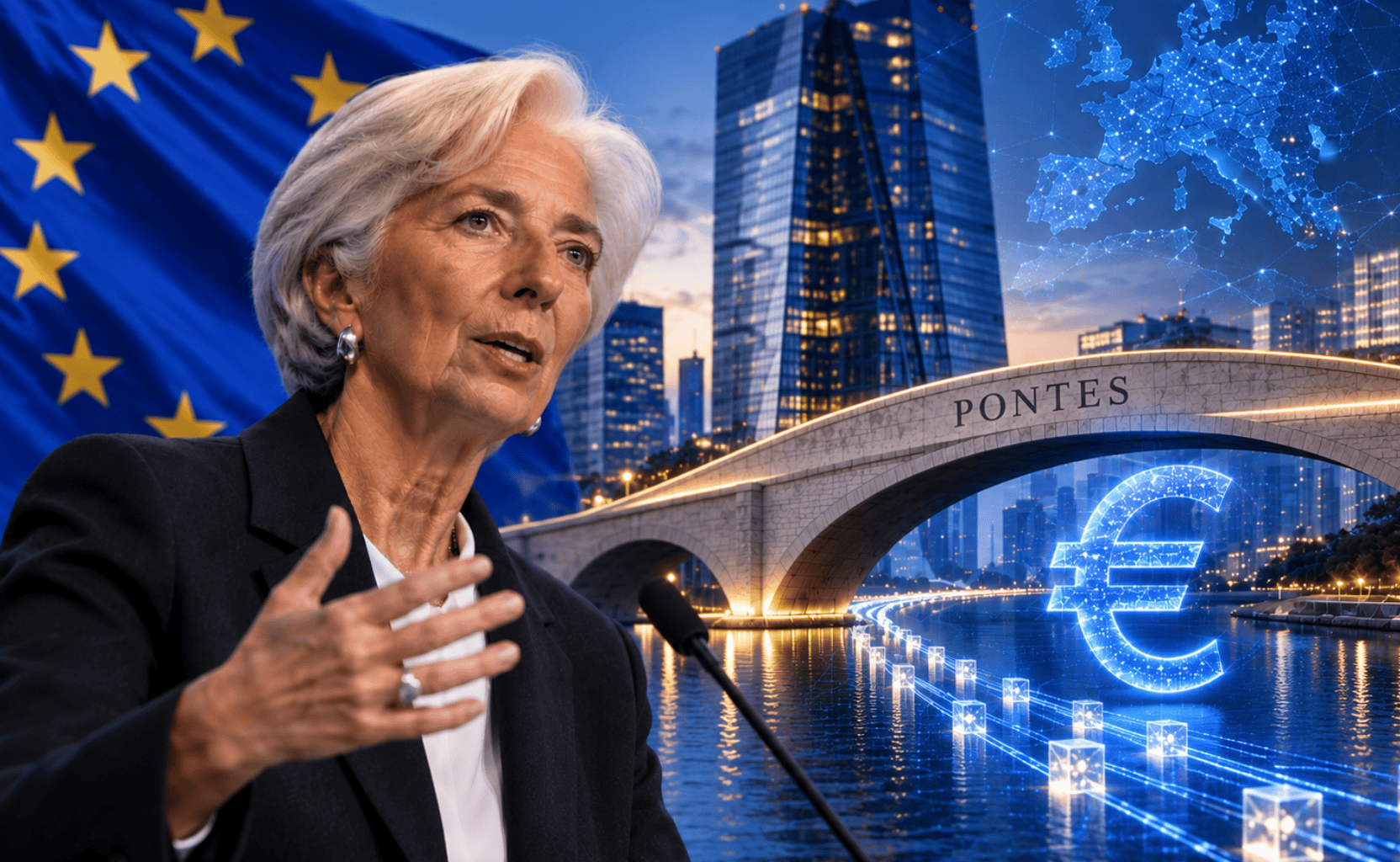
As Europe moves forward with its digital euro project, another, less visible change is taking place at the infrastructure level: adapting central bank money to financial markets where assets are increasingly being issued, traded and settled digitally.
One example is Pontes, a new Eurosystem infrastructure launched in September 2026 that enables transactions involving tokenised assets to be settled using central bank money. To understand why this matters, it helps to look first at what is happening to the assets themselves.
From traditional assets to tokenised assets
Tokenisation is the process of representing an asset digitally through a token. That token can be used to record ownership and facilitate certain transactions involving the asset in a digital environment.
So far, much of the discussion around tokenisation has focused on financial assets such as bonds, funds and securities. But the idea goes further. It can also apply to assets that exist in the physical world, and gold is a good example.
Imagine a quantity of physical gold stored securely. Traditionally, buying, selling or managing that gold requires processes and structures built around a physical asset. Tokenisation offers another way of doing things: creating a digital representation linked to that physical gold.
The gold does not disappear, and it does not become a purely digital asset. The gold remains physical. What changes is how its ownership can be represented and managed digitally.
Gold is only one example. The same concept can be applied to a growing range of financial and real-world assets.
But if the asset becomes digital, what happens to the money?
This is where things get interesting.
If an asset is represented digitally, how do you actually pay for it? Most of the money we use today is already digital, but not all digital money is the same.
The balance in a bank account is commercial bank money. Banks, in turn, use central bank money to settle certain transactions within the financial system. Until now, these two sides of the system have largely operated through traditional infrastructure.
Tokenisation introduces another possibility: the asset and the money used to pay for it can interact within digital infrastructure. This is where Pontes comes in.
So, what is Pontes?
Pontes is a new Eurosystem infrastructure designed to connect platforms used for transactions involving tokenised assets with Europe's existing payment infrastructure. Its purpose is to allow these transactions to be settled using central bank money.
The name is fitting. Pontes means “bridges” in Latin. In practical terms, it is intended to connect the world of tokenised assets with the existing monetary infrastructure of the euro area.
Christine Lagarde: money is changing too
The broader shift has also been highlighted by Christine Lagarde, President of the European Central Bank.
In a June 2026 speech titled Money in transition, Lagarde described how technology is changing the way money and financial markets work. One line captures the idea particularly well:
“Technology is rewriting how money is exchanged and trades can be settled, most of all through tokenisation.”
She also described a future in which ownership of an asset and the corresponding payment could be recorded almost simultaneously on a shared digital infrastructure.
For the European Central Bank, this raises an important question: if financial markets become increasingly digital and tokenised, should the money used to settle those transactions be able to operate in the same environment?
That is part of the context behind Pontes.
Is Pontes the digital euro?
Not exactly, and this distinction matters.
When people talk about the digital euro, they are generally referring to a possible form of central bank money that could be used by individuals and businesses for everyday payments. Pontes serves a different purpose. It is primarily concerned with financial markets and transactions involving tokenised assets.
The two are different projects, but they sit within a broader shift towards a more digital monetary and financial system.
So Pontes is not the digital euro that someone might eventually use to buy a coffee. It is part of a different transition: adapting financial infrastructure to markets where assets can increasingly exist and move in digital form.
Why does settlement matter?
Consider a simple transaction. An investor wants to buy a tokenised asset for €1 million. The asset exists as a digital representation, but the money still has to reach the seller.
In a traditional system, the asset and the money move through different systems and participants before the transaction is finally settled. In a tokenised environment, there is an opportunity to coordinate the two movements: the buyer receives the asset while the seller receives the money, with both being settled as part of the same transaction.
This is known as Delivery versus Payment (DvP). Pontes is designed to facilitate this kind of connection between new digital asset infrastructure and Europe's monetary system.
It is not just about central bank digital money
The conversation around digital money extends well beyond the ECB.
We are already seeing different forms of digital money and digital assets emerge. These include stablecoins, generally issued by private companies; tokenised deposits issued by commercial banks; central bank money used within new digital financial infrastructure; and tokenised assets, including financial securities and real-world assets.
Each comes with different characteristics, risks and potential use cases. The future is therefore unlikely to be as simple as replacing traditional money with one new form of digital money.
Instead, we may see different forms of digital money interacting with increasingly tokenised assets. How these systems connect will be one of the important questions for the financial system.
From the digital euro to a tokenised economy
When people discuss the future of the euro, the conversation often starts with a simple question: will we eventually use a digital euro in our everyday lives?
There is another question worth asking: how will the euro work in markets where financial and real-world assets are increasingly digital?
Pontes is one response to that second question.
And tokenised gold offers a practical example of what this broader shift can look like.
At Phi Wallet, we have been working in this space since 2023, tokenising physical 24-karat gold and linking ownership of that gold to a digital financial experience. The point is not to turn a physical asset into something purely virtual. It is to use digital infrastructure to change how people can access, manage and transfer ownership of real assets.
But the conversation is moving beyond whether individual assets can be tokenised. The bigger question is becoming how we connect digital assets, digital money and the infrastructure that allows them to interact.
Pontes is one piece of that puzzle. The digital euro is another. And the tokenisation of real-world assets, including gold, represents another side of the same transformation.
The change is not simply about making money digital. It is about building a financial system where money, assets and the infrastructure connecting them can operate together in an increasingly digital environment.

